Nature's God by Matthew Stewart
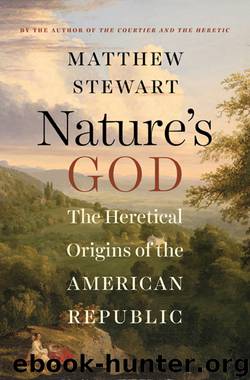
Author:Matthew Stewart
Language: eng
Format: epub
Publisher: W. W. Norton & Company
As therefore the highest perfection of intellectual nature lies in a careful and constant pursuit of true and solid happiness, so the care of ourselves, that we mistake not imaginary for real happiness, is the necessary foundation of our liberty. The stronger ties we have to an unalterable pursuit of happiness in general, which is our greatest good, and which, as such, our desires always follow, the more are we free from any necessary determination of our will.84 [emphasis added]
There is more than a little historical irony in the fact that the “pursuit of happiness,” long taken to stand for the thoughtless, selfish, amoral consumerism and materialism that splashes around at the shallow end of American culture, actually originated from a philosophy that identifies happiness with virtue and the improvement of the understanding.
From the Lockean-Spinozist claim that virtue is understanding—which is at bottom just a reprise of a tune from Socrates in the key of early modern philosophy—it follows conversely that vice is misunderstanding. Thus, contrary to the common conception, vice is not the pursuit of self-interest at the expense of virtue, but the dissolution of the self that occurs when we act through inadequate ideas, or what Spinoza and Locke identify as the passions, or passive emotions. And in fact, since most people operate with rather inadequate ideas of themselves and the world, according to both Spinoza and Locke, most people find themselves at the mercy of self-destructive passions. Which is to say, people are generally vicious and corrupt, not because they act as rational calculators of self-interest, but because they fail to do so.
The conception of virtue as understanding also returns us with greater insight to the mildly ascetic side of Epicureanism. The common view—often falsely associated with Epicurus, Hobbes, Spinoza, and their heirs—says that freedom consists in the unfettered ability to satisfy every impulse that surges into consciousness. But the radical view says that the random satisfaction of urges is the essence of unfreedom. The indulgence of the appetites, says Spinoza, reflects “a weakness of the mind” rather than “an instance of the mind’s freedom.” As we chase down the false objects of our passions, the first thing that we lose is ourselves. Conversely, “freedom is the greater as a man is more able to be guided by reason and control his appetites.”85
Although the idea of virtue as understanding that emerges from the Epicurean revival involves a number of complexities and can be debated much further, its most important message can be summarized in three basic propositions. The first is that every person or thing necessarily pursues its own idea of the good.86 This is the premise that motivates the rejection of the doctrine of free will and that expresses the deep rationalism of Epicurean hedonism: that all of our actions are explicable. Spinoza calls this proposition a “law of nature”—as does Paine. Pope articulates it in another one of his distinctly Spinozistic couplets:
Download
This site does not store any files on its server. We only index and link to content provided by other sites. Please contact the content providers to delete copyright contents if any and email us, we'll remove relevant links or contents immediately.
The remains of the day by Kazuo Ishiguro(8961)
Tools of Titans by Timothy Ferriss(8357)
Giovanni's Room by James Baldwin(7313)
The Black Swan by Nassim Nicholas Taleb(7097)
Inner Engineering: A Yogi's Guide to Joy by Sadhguru(6780)
The Way of Zen by Alan W. Watts(6589)
Asking the Right Questions: A Guide to Critical Thinking by M. Neil Browne & Stuart M. Keeley(5749)
The Power of Now: A Guide to Spiritual Enlightenment by Eckhart Tolle(5740)
The Six Wives Of Henry VIII (WOMEN IN HISTORY) by Fraser Antonia(5493)
Astrophysics for People in a Hurry by Neil DeGrasse Tyson(5172)
Housekeeping by Marilynne Robinson(4432)
12 Rules for Life by Jordan B. Peterson(4298)
Double Down (Diary of a Wimpy Kid Book 11) by Jeff Kinney(4257)
The Ethical Slut by Janet W. Hardy(4235)
Skin in the Game by Nassim Nicholas Taleb(4231)
Ikigai by Héctor García & Francesc Miralles(4228)
The Art of Happiness by The Dalai Lama(4118)
Skin in the Game: Hidden Asymmetries in Daily Life by Nassim Nicholas Taleb(3985)
Walking by Henry David Thoreau(3948)
